☖ Home Units Converter Geometry Σ Math Physics Electricity

belt-and-pulley system calculator

Print two circles track calculator
Circles of the form:
(x − a)2 + (y − b)2 = r2
or
x2 + y2 + Ax + By + C = 0
Circle 1:
(
x
)
2
 + (
y
)
2
=
2
x
2
+ y
2
+
 x 
+  y  +  = 0
Circle 2:
(
x
)
2
 + (
y
)
2
=
2
x
2
+ y
2
+
 x 
+  y  +  = 0

First circle radius (R)
Second circle radius (r)
Distance of circles centers (d)
Angle (θ)
Angle (α)
Length (h)
Belt length (L)
Angle γ
Notes:
Angular velocity of pulley − R (ωR)
Angular velocity of pulley − r (ωr)
      Degree   Radian       

belt-and-pulley system summary

Print belt-drive

hyperbola description
A belt drive transmits power from an engine to a machine using belts, allowing the driven speed to be controlled by the diameters of the pulleys. Belt drives are widely used in cars to drive the oil pump, water pump, and to manage engine timing. Belts come in various forms — flat, V‑belt (conical), circular, grooved, toothed (timing belts), and chain belts — chosen for different applications and for accuracy of rotation.
Angular displacement
R/r=θ_r/θ_R
Angular velocity
R/r=ω_r/ω_R
θ − angle in radians [rad]
ω − Rotational velocity      
ω=dθ/dt
in radians per second
[rad/s]
α − angular acceleration      
α=dω/dt=(d^2 θ)/〖dt〗^2
in radians per square second
[rad/s]
Geometric properties of belt drives, notice that angles     θ+α=180°
The central angle formed by the difference of the radii is:
γ=sin^(-1)⁡〖(R-r)/d〗
Wrap (contact) angles of radius  r (α)  and  R (θ):
α=2 cos^(-1)⁡((R-r)/d)
θ=2(π-α)=2[π-cos^(-1)⁡((R-r)/d) ]

Belt contact arcs of radii  r  and  R:
Lr = r α = r (2π − θ)
LR = R θ = R (2π − α)

total track length L is: L = 2h + rα + Rθ = 2h + r(2π − θ) + Rθ

Where h is equal to:
h=d sin⁡〖α/2〗=√(d^2-(R-r)^2 )
If the circles are given by the equations:
(x − a)2 + (y − b)2 = R
(x − c)2 + (y − d)2 = r
If the circles are given by the equations:
x2 + y2 − Ax − By + C = 0
x2 + y2 − Dx − Ey + F = 0
The distance between centers is:
d=√((A-D)^2+(B-E)^2 )
The radii of the circles are:
R=1/2 √(A^2+B^2-4C)  r=1/2 √(D^2+E^2-4F)

Relative conditions for two circles locations

Print relative conditions for two circles locations
Drawing Condition
Circle in circle
Circles equations: (x − a)2 + (y − b)2 = r02
(x − c)2 + (y − d)2 = r12
Distance between circles centers: Distance between circles centers
d < |r0 − r1|
Circle in circle
Inner tangency
d = |r0 − r1|
Circle in circle
Outer tangency
d = r0 + r1
Circle in circle
Intersecting circles
|r0 − r1| < d < r0 + r1
Circle in circle
Two separate circles
d > r0 + r1

Track calculation example

Print relative conditions for two circles locations
Circular track example
Two pulleys of  20 cm  and  10 cm  radii are connected by a belt. The distance between the centers of the pulleys is  0.5 m.  Find the length of the belt and the angular velocity of the big pulley if the small pulley is rotating at   a rate of  100 rpm.
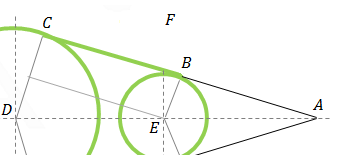
Circular track example
Figure - 1
From figure 1 we see that triangles  ACD  is similar to triangle  ABE (all the angles are the same). We have the relations:
sin⁡γ=r/b=R/(a+b)
Now we can find the value of  b:
b=ra/(R-r)=(0.04∙0.7)/(0.1-0.04)=0.466 m
Calculate the angle  γ  by the equation:
γ=sin^(-1)⁡〖r/b〗=sin^(-1)⁡〖0.08/0.466〗=9.9
deg
The value of  h  can be calculated by Pythagoras theorem:
h=√(a^2-(R-r)^2 )=√(〖0.5〗^2-(0.2-0.08)^2 )=0.485m
Angle ω is:
ω = 90 − γ = 90 − 11.5 = 78.5 deg
Track arc length of the big pulley is: L_R=R2(180-ω)=0.2∙2 ((180-78.5))/180 π=0.71 m
Track arc length of the small pulley is: L_r=r2ω=0.1∙2∙78.5/180 π=0.27 m
The length of the belt is:
L = LR + Lr + 2h = 0.71 + 0.27 + 2 * 0.485 = 1.95 m
The circumference of the big and the small pulleys are:
CR = 2 π R
Cr = 2 π r
When the small pulley is performing 1 rotation the big pulley will make  r / R  rotations.
The angular velocity of the big pulley is:
V_R=r/R V_r=0.1/0.2 100=50
  rpm
And the angular velocity in  rad / s  is:
  ω_R=(50∙2π)/60=5.24
  rad / s


