Since the time of the ancient Greeks, when geometry was highly developed, mathematicians and artists sought
a proportion considered the most pleasing and aesthetically balanced relationship between the width and height
of a rectangle. This proportion is known as the golden ratio, represented by the symbol φ (phi).
The golden ratio has been widely used throughout history and continues to play an important role today in architecture,
design, art, photography, book layouts, web design, and many other fields, especially in visual presentations. One of the
best-known architectural applications of the golden ratio is the façade of Greek columns.
The value of φ is approximately 1.618 but we have to remember that it has infinite number of digits after the point
as the value is an irrational number. This number can be derived by geometry to be equal to the positive value of the square:

The value of φ is derived from the definition of the golden ratio to be:

The geometric description of the golden ratio is by a circle who's radius is:
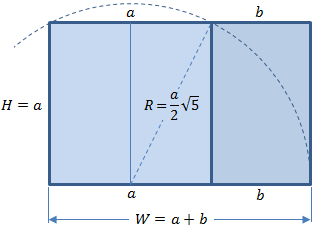
One interesting property of the Fibonacci sequence is that the ratio of two consecutive terms converges to
the golden ratio. The accuracy of this approximation improves as the terms become larger (see values below).
Fibonacci sequence division:
The Fibonacci sequence is a series of numbers where each number is the sum of the two preceding ones.
It usually starts like this: 0, 1, 1, 2, 3, 5, 8, 13, 21, 34, 55, 89, ...
It shows up in nature (like flower petals and spirals), math, computer science, and even art.
Genaral term is defined by: Fn = Fn-2 + Fn-1.
 ☖ Home
⇄ Units Converter
⧉ Geometry
Σ Math
✈ Physics
〶 Electricity
☖ Home
⇄ Units Converter
⧉ Geometry
Σ Math
✈ Physics
〶 Electricity