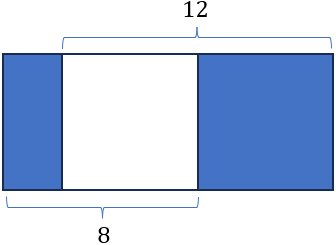
At first glance, it may seem that this problem has no solution because the height of the rectangle is not given. However, let us start solving the problem and see what happens.
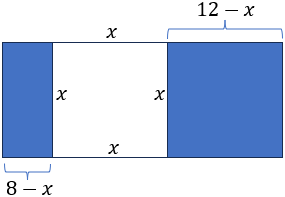
We can now see that the side lengths of the rectangle are: (x) and (8 − x) + x + (12 − x).
Adding the two side lengths and multiplying the sum by 2, we obtain the perimeter of the rectangle:
P = 2[x + 8 − x + x + 12 − x] = 2[x + 20 − x] = 40
Although the value of (x) cannot be determined uniquely, we can still determine the perimeter of the rectangle. When we write the expressions for the side lengths and add them to obtain the perimeter, all terms containing (x) cancel out. This is not a coincidence: the contributions of the square to opposite sides of the rectangle balance each other. As a result, the perimeter depends only on the two given distances, (12) and (8), and is independent of the height of the rectangle. Therefore, the perimeter has a unique value even though (x) can take infinitely many possible values. In other words, the dimensions of the rectangle are not uniquely determined, but its perimeter is.
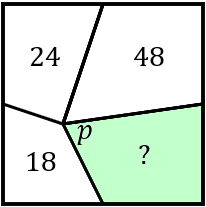
Since the only information given about the quadrilateral is the areas of three of the four regions and the fact that each region has two sides of length (s), the available data are insufficient for a direct solution. Therefore, we must adopt a different approach to determine the area of the fourth region.
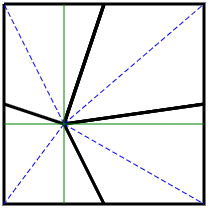
Finally, draw perpendiculars from point P to the sides of the square (shown in green). These perpendiculars represent the heights of the eight triangles.
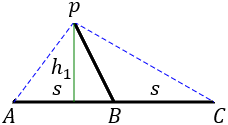
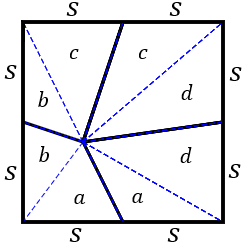
Let us focus on the lower side of the square. The two triangles (PAB) and (PBC) have the same base length, (s), and the same height, (h1). Therefore, they have equal areas. Let the area of each triangle be denoted by (a).
Similarly, we denote the areas of the corresponding pairs of triangles along the other three sides of the square by (b), (c), and (d).
Using these definitions, we obtain the following area equations:
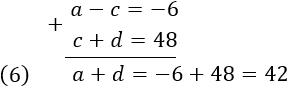
Notice that we have only three equations but four unknowns. Therefore, the areas of the individual triangles cannot be determined uniquely. Fortunately, this is not necessary, since our goal is only to find the value of (a + d).
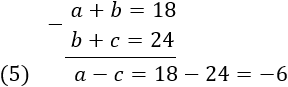
Subtract equation (2) from equation (1) to eliminate (b):